


Runners: Don't Get Caught in the Off-Season Trap!

Your calendar is a lie—2027 training already started!

Stop Waiting for the New Year (or a Training Plan to Start)
It's a common mindset: 'I'll start back up after the holidays.' And boy do I get it! For many of us, the last six weeks of the calendar year present many obstacles to training—not to mention a ton of additional emotional and physical stress.
But truthfully, you’re giving up incredibly valuable time—time that could move the fitness needle in a real way!
Here's the thing: true long-term fitness growth doesn't happen in a single 20-week training cycle. It happens through many consecutive training cycles.
I’m commonly asked, “How much time do I need to train for X race?” The answer is: “As much time as you have!” Don’t waste it. The amount of time you have available obviously changes how we build your next block—but if you’re just waiting around for training to start, you’re doing it wrong!
Training isn’t a switch you flip on or off — it’s momentum you build month to month, season to season, year to year. The more you look at any stretch of time as a chance to do something with purpose to move your fitness forward, the more progress you’ll make.
And, if you want to reduce your injury risk, this is one of the biggest changes you can make, aside from adaptive training!
The Problem With a Long Off-Season for Runners
Now, it’s important to start by saying: depending on your recent training, it might be the right call to take some recovery time during the holidays. If you’ve been training hard and raced a long event in mid-November, it might be the right time to back off, especially through late November and early December.
Yes, recovery is a purpose—it counts as training! When I say “off-season,” I’m referring to taking time totally away from any purposeful training decisions. That’s different. Time to recover from both the race and the block leading up to it is important, and intentional.
But “off-seasons” are often misunderstood by runners, both in length (entire seasons) and in concept (entirely off, or entirely purposeless). For everyone except world-class runners—let’s be real, that’s everyone reading this—that mindset leaves a lot of potential growth on the table.
In short: world-class runners have already built 98% of the fitness they’ll ever have. Their training is focused on sharpening that fitness for specific events, and getting those last 2%. For those runners, off-seasons are more beneficial than detrimental. But most of us? We’re still well below 90% of our potential, and we definitely shouldn't be mimicking the elites.
Elite runners aren't fit because of their training, their training looks the way it does because they're already fit.
When you train seasonally, taking 6+ weeks without purpose between training cycles or plans, you’re slowing down the long-term momentum that actually drives progress.

The philosophy of switching sports or activities entirely during the winter has also been popularized, often by elite athletes. The most well-known examples are nordic skiing and ski mountaineering. That really should be the subject of an article all its own, but I’d caution most recreational-level athletes against jumping completely on that train. Adding fun activities that you enjoy is absolutely worthwhile, but these sports are quite different from one another. While aerobic development obviously has huge crossover, running has a lot of specific demands—mechanical and otherwise—and jumping from one sport to another suddenly can lead to injuries if it isn’t done carefully.
What Long-term Structure Might Look Like
Like any good training, long-term structure will look different depending on your athletic history, current strengths and weaknesses, and your long-term goals. By goals, I don’t mean your next race. I mean the runner you want to be five years from now.
Let's dig into a real example as a case study—though keep in mind that there are a variety of ways this can be done. The emphasis is on having a plan that extends beyond your next race.
Case Study
A 40-year-old runner has been doing one to two marathons per year for the past eight years. Their PR is 3:39, from a few years ago, and they've come within a few minutes of that at most of their recent races.
Each race has been preceded by a 16–20 week marathon-specific plan. During those blocks, they generally have peaked at 50–60 miles per week, had regular race-prep long runs, and done plenty of threshold work, marathon-pace efforts, Yasso 800s, and mile repeats. Sometimes they’ll race a half marathon during the build-up, and they almost always run the local Turkey Trot with their family. Then? Back to waiting for the next training cycle.
Sound familiar? I guarantee you know runners like this—maybe you are this runner.
So how do we help this athlete actually level up their fitness? At 40, there’s still plenty of time to build, adapt, and grow. They’re not racing the clock just yet!
Analysis Let’s start with all that they’ve done right: a strong history of marathon racing experience (huge!), regular long runs, solid peak mileage, and plenty of time spent near their marathon effort. They’ve also done a fair amount of moderate to moderately hard running with those Yasso-800's and mile repeats.
So what's missing?
What I most often see in runners like this is a lack of focused development in speed and running economy. Here’s the truth: unless you’re already a very fast runner, a mile repeat is not speedwork. Yasso-800's definitely aren't speedwork.
Learn more about why it's not speedwork here!
For a 3:39 marathoner, mile repeats usually end up around 7:00 pace—fast enough to feel hard, but not fast enough to significantly improve running economy or top-end distance speed. At that effort, you’re building aerobic strength, not truly working on speed. That same runner could likely run 1–3 minute intervals around 5:40–6:00 pace—yielding far greater adaptations for speed and running economy.
The Longer-Term Plan
First, one of the most helpful things a runner like this can do is take a training block or two away from the marathon. Not time off—but time to shift the training lens. That means training (and racing!) shorter distances. Learning to pace a 5K or 10K sharpens your mental game, strengthens your top-end output, and gives you frequent, low-stress (and cheap!) opportunities to practice racing.
In this phase, mileage doesn’t need to stay quite as high as in a marathon-specific block, but intensity and quality usually increase. That means true speed development: lots of strides, short intervals, VO₂max intervals, and turnover-focused efforts that challenge the neuromuscular and biomechanics systems and improve running economy. When you raise your ceiling, everything underneath it improves!
Too often, runners are afraid to step away from marathon training because they think it means losing fitness. In reality, this kind of structured variety is exactly what improves your fitness—and marathon times—over the long term.
Next, focus on increasing your capacity to handle more training volume. There are a lot of ways to do this, but often, by removing the pressure of a deadline and training more adaptively, you can build the strength and resilience needed to start your next block from a stronger place, already handling a higher level of mileage.
Combine these, and you get something really cool: a runner with a more powerful and economical stride and well-rounded fitness, who is now developing the ability to tolerate 60-70 mile weeks instead of 50-60, and tolerate them more consistently. They are refining their ability to race frequently across multiple distances and learning how many external variables go into a race performance.
So what’s next? It depends, but one option is to move up in distance and work on races that are more intense than the marathon, but still require a long-distance mentality, like the 15K, 10-mile, or half marathon. For the runner above, these distances also represent efforts closer to lactate threshold. While they may trained a lot at that effort, they probably haven't raced at that effort. Once you approach the longer end of that range, you also get valuable practice with gear, fueling, and race-day logistics.
While all of these phases support racing the marathon (and beyond!), they should be approached with the same purpose and commitment as marathon training itself. This isn’t a detour, or a break from the marathon, but essential training that builds you into a stronger, more complete runner.

What You Gain by Starting Now
Let's say you are planning on racing a marathon at the end of May. That means that 16-week plan you found/bought kicks off in early February. That means you've got 8-10 weeks right now to work on building your fitness in ways that your marathon plan will ignore. Don’t waste that window (unless you genuinely need recovery). Use it to train with purpose, strengthen your weaknesses, improve your running economy, and set yourself up for a smoother, more effective spring build.
You also give yourself a lower-stress period to ease into a training routine and stay consistent. And even while you're working on those weaknesses, you're still giving yourself a head start on the all-important aerobic base and injury-resistance!
Even better? Let this “pre-season” phase bleed into the start of your marathon training. You don’t have to make a clean switch! Instead, you get extra weeks to prepare, while continuing to work on long-term development alongside the start of your structured block. That’s how you set a higher baseline before the real grind begins.
Most likely you will look at the beginning of your marathon training plan with a laugh as you realize how little it's asking of you.
So you’ve built momentum, raised your ceiling… and now your plan wants you to do less?
What do you do then?

Coaching Vs. Static Plans
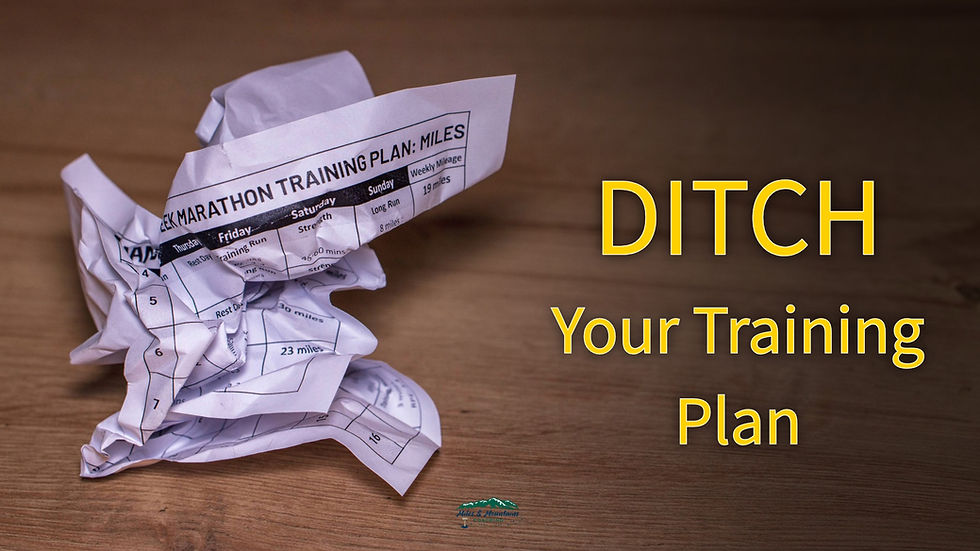
Well this brings us to an important point. Training plans… they aren’t great. Really. Many aren’t based in science at all, but even at their best, they fail in five ways: they’re designed backwards, they tend to be linear, they aren’t adaptive, they aren’t specific to you as an individual, and they don’t account for how fitness grows over the long term.
You can read a lot more about them here.
Effective training starts where you are now—not where you want to be. It adjusts week by week, matching your adaptation rate, recovery, and lifestyle needs, and focuses on actually improving your fitness, not just checking off the boxes.
This whole article was based on an example that might not be you. Training has to be based on your strengths and weaknesses, not someone else's.
The very best way to truly level-up your training and make long-term progress is to work with a coach, or even self-coach if you have the time. Jumping from one training plan to the next, even with some structured periods in between, just isn’t going to accomplish the same things.
Seriously, read that article for way more info about this!

Training is a Long Game
In truth, most athletes, no matter their experience level, expect training adaptations to happen much more quickly than they actually do. We tend to think in terms of “I did X workout last week, so I should feel faster or stronger this week.” But your body doesn’t work on that timeline. Most meaningful adaptations to a given run, workout, or training load show up on about a 4–6 week delay—sometimes longer. What you feel today is mostly the sum of what you’ve been doing for the last month or two, not what you did yesterday.
That delay can be frustrating if you’re in a hurry… or incredibly powerful if you start thinking long-term. When you add strides three times a week for eight weeks, you might not feel magically faster by the end of week one—but a month or two later, your “normal” easy pace is smoother, your form is sharper, and those marathon-pace efforts suddenly feel more relaxed. When you slowly nudge your weekly mileage up over a year (rather than cramming it into a 16-week plan) you’re not just surviving bigger weeks, you’re building a body that craves them.
This is why the classic seasonal “training plan” cycle feels so rough. If you only really train with intent and purpose during that 16–20 week window, you’re forever trying to haul your fitness up to whatever the plan demands. You cram in volume, race, shut it down, lose momentum, and then start again from roughly the same place. Instead of compounding your adaptations, you keep rebuilding lost ground. That’s not long-term growth—that’s just treading water.
Zoom out to 12–18 months and it’s a completely different game. Perfection stops mattering. The missed sessions or lackluster weeks from illness or work chaos become background noise instead of failure.
The overall trend is still upward and forward. You can have multiple training blocks focused on speed, durability and volume, or race-specific demands—and they all stack.
If you have big goals for 2027 and beyond, this is what you want to be thinking about. The decision to start now isn’t about squeezing in a few extra workouts before your next race. It’s about accepting that the runner who shows up on start lines in 2027, 2028 and beyond, is being built right now, through this winter, and even further—well beyond your next training cycle.
Training is a long game—so the sooner you start playing it that way, the more room you give yourself to actually become the athlete you want to be.
Your Next Breakthrough is Built Right Now
If you’ve read this far, you probably don’t just want to survive races in 2027—you want to build a stronger, faster, fitter, more prepared version of yourself. That doesn’t happen by downloading another 16-week plan and hoping this one is “the one.”
It happens by treating the next 12–18 months like they matter, starting now, not when the calendar flips or your plan tells you “Week 1.” It happens by trusting that you're doing the right things at the right time to support your fitness, not always wondering.
That takes time and knowledge, or it takes expert help.
If You're Interested...

That’s where working with a coach comes in. Instead of starting with a race date and a spreadsheet, we start with where you are right now—your history, your fitness, your schedule, your goals—and build forward.
We map out the long view, choose smart stepping-stone races, build in real recovery, and then adjust it all week by week as your body (and life) respond.
The goal isn’t to just survive a plan; it’s to become the kind of runner who can stack months and years of purposeful training without burning out.
I’m currently welcoming new athletes who are ready to play the long game and truly find their limits in 2027 and beyond. If you want help turning this concept into actual training—with structure, adaptability, accountability, and a coach in your corner—you can learn more here, or schedule a free Intro Chat, and we’ll see if it’s a good fit.
Your next PR doesn’t start with a training plan. It starts with a long-term belief that you're capable of more. And you are.

Comments